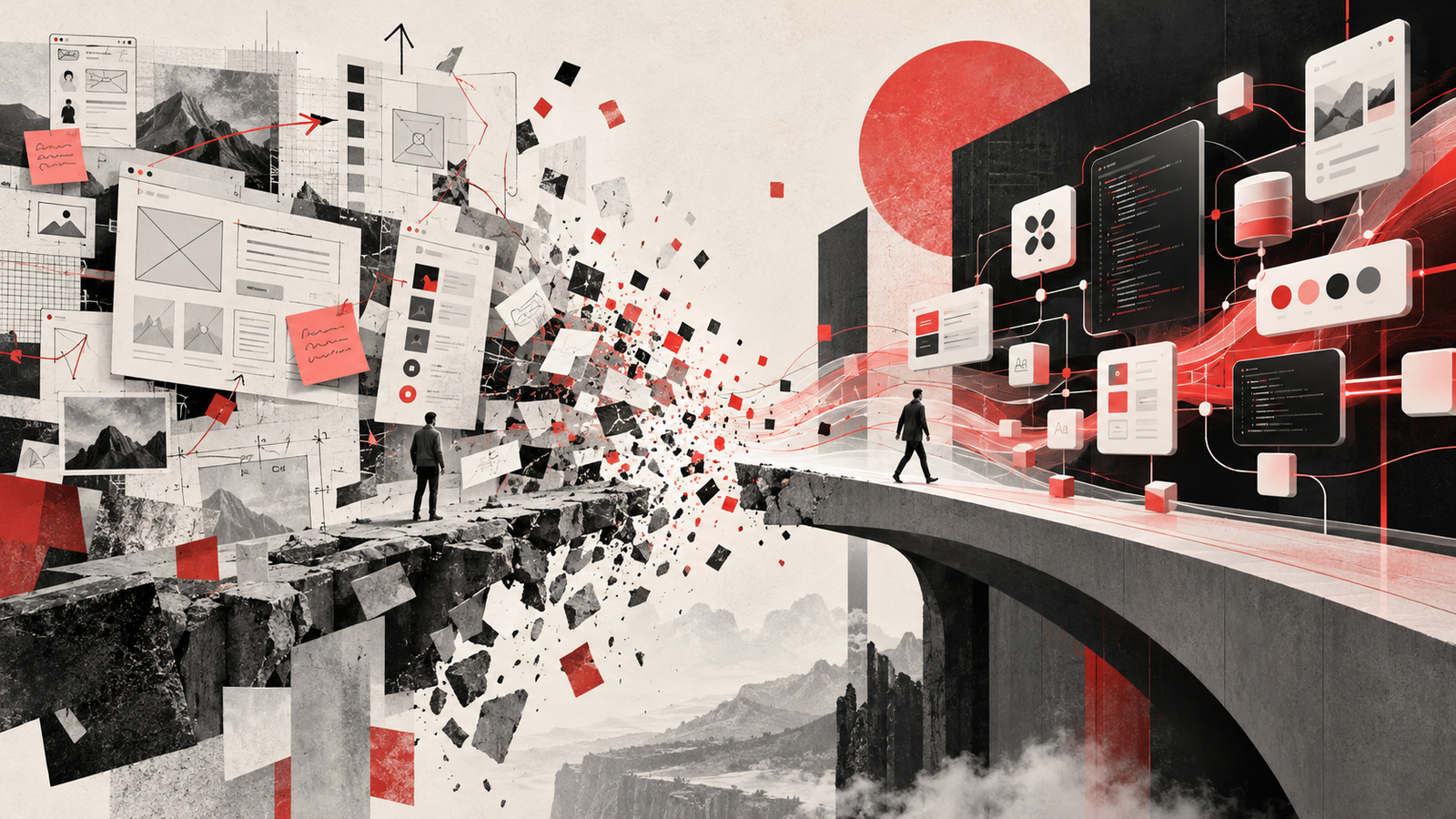
The Great Collapse: How AI Is Destroying the Design Handoff (And Why That's a Good Thing)
For twenty years, the design handoff was a sacred ritual in product development. Designers would craft pixel-perfect mockups in tools like Sketch or Figma, annotate every spacing value and color token, export assets at 1x, 2x, and 3x, and then — with a mixture of hope and dread — hand it all over to developers. What followed was predictable: misinterpretations, "this doesn't look like the design" reviews, endless Slack threads about border-radius values, and a quiet erosion of trust between two groups that were supposed to be on the same team.
In 2026, that ritual is dying. Not slowly, not at the margins — it's collapsing at the foundation. And the implications for UX design are far more profound than anyone in the industry is fully reckoning with.
The Handoff Was Always Broken
Let's be honest: the design handoff was never a good process. It was a workaround for a structural problem — the fact that design and development operated in fundamentally different paradigms with fundamentally different tools.
Designers worked in visual canvases. Developers worked in code. The handoff was the bridge between these two worlds, and it was always lossy. Information degraded in translation. Context evaporated. The developer receiving a Figma link had no access to the user research that informed the design, the stakeholder constraints that shaped the trade-offs, or the designer's mental model of how the interface should behave at the edges.
A 2024 Figma survey found that designers and developers spend an average of 4.5 hours per week on handoff-related communication — clarifying specs, resolving discrepancies, and re-explaining decisions that should have been captured the first time. Multiply that across the millions of product teams worldwide, and you're looking at billions of dollars in lost productivity annually.
But the time cost was the least of the problems. The deeper issue was accountability fragmentation. When a shipped feature didn't match the design, who was responsible? The designer who "didn't spec it clearly enough"? The developer who "didn't read the annotations"? The PM who "didn't allocate enough time for QA"? The handoff created a blame gap — a no-man's-land where quality went to die.
Enter the Machines (and the MCP Revolution)
The collapse began with Dev Mode. When Figma launched Dev Mode in 2023, it was a step toward bridging the gap — giving developers a dedicated view of design files with code-friendly measurements, variable mappings, and component properties. It was useful, but incremental. The fundamental paradigm remained: designers design, developers interpret, and the handoff persists.
What changed everything was the arrival of Model Context Protocol (MCP) and the AI coding assistant revolution.
In early 2025, Figma launched its MCP catalog — a system that allows AI coding tools like Cursor, Claude Code, and GitHub Copilot to directly read Figma design files and translate them into production code. Not mockup code. Not prototype code. Production-ready component code that respects your design system tokens, your naming conventions, and your architectural patterns.
This is not a better handoff. It's the elimination of the handoff as a distinct phase.
Here's what the workflow looks like now at leading-edge product teams:
- A designer updates a component in Figma.
- An AI agent detects the change via MCP, reads the component's properties, constraints, and design tokens.
- The agent generates or updates the corresponding React/Vue/Swift component in the codebase.
- A pull request is automatically created with a diff showing exactly what changed.
- A developer reviews the PR — not to "implement the design," but to verify that the generated code meets architectural standards.
The designer never "hands off" anything. The design is the source of code. The gap between intention and implementation has been compressed from days to minutes.
What This Means for UX Designers
If the handoff disappears, what happens to the UX designer? This is the question that's keeping design leaders up at night, and the answer is more nuanced than the doom-scrolling suggests.
What's dying: The role of the designer as a spec-writer. If AI can read a Figma file and generate code, the designer who adds value primarily through meticulous annotation, redlines, and asset export is indeed becoming obsolete. This is the "execution layer" of design work, and it's being automated just like execution layers in every other profession.
What's being born: The role of the designer as a system architect. When the tactical work of specifying pixels is automated, the strategic work of defining what should be built and why becomes the core value proposition. This means:
- Design system governance becomes a first-class discipline. If AI is generating code from your components, the quality of your design system directly determines the quality of your shipped product. A poorly maintained design system doesn't just create visual inconsistency — it generates bad code at scale.
- User research becomes more important, not less. When the cost of implementation drops, the cost of building the wrong thing rises proportionally. The teams that win will be the ones with the deepest understanding of user needs, not the ones with the fastest AI code generation.
- Cross-functional collaboration shifts from handoff to co-creation. Designers and developers still need to work together, but the collaboration moves upstream — to defining requirements, evaluating trade-offs, and making architectural decisions. The conversation changes from "here's what I designed, please build it" to "here's the user problem, let's figure out the best solution together."
The New Bottleneck: Decision-Making, Not Implementation
Here's the paradox that most industry commentary misses: making implementation easier doesn't make product development easier. It makes it faster, which puts more pressure on the parts that can't be accelerated — namely, decision-making.
When a team can generate working code in minutes instead of days, the bottleneck shifts to:
- What should we build? (Strategy)
- For whom? (Research)
- What does "good" look like? (Design quality)
- How do we know if it's working? (Measurement)
These are all fundamentally human, fundamentally UX-adjacent questions. The collapse of the handoff doesn't eliminate the need for designers — it elevates the floor of what constitutes valuable design work.
Consider the analogy with manufacturing. When CNC machines and 3D printing automated the production of physical parts, the role of the mechanical engineer didn't disappear. It shifted from "how do I make this part?" to "what part should I make, and what are the tolerances?" The engineers who thrived were the ones who moved up the value chain. The ones who didn't, got replaced.
Case Study: The Teams That Are Already There
This isn't theoretical. Several high-profile product teams have already made the transition.
At Stripe, the design systems team rebuilt their component library in early 2025 with AI code generation as a first-class output. Designers no longer maintain a separate "design spec" — the Figma component is the spec. When a designer updates a button variant, the corresponding React component is automatically updated via MCP. The result: design-to-production time for new features dropped by 60%, and the design team reallocated those saved hours to user research and usability testing.
At a mid-size fintech startup (featured in Figma's 2025 State of the Designer report), a team of three designers and eight developers eliminated their weekly "design review" meeting entirely. Instead, developers review AI-generated PRs, and designers participate in code review from a design-quality perspective. The meeting time was replaced with asynchronous video walkthroughs that designers record in 5 minutes using Loom.
At Accor (the hospitality group), designers use Figma's AI tools to generate multiple design variations, test them with users in FigJam sessions, and then push the winning designs directly into the codebase. The design-to-test-to-ship cycle that used to take three weeks now takes four days.
These teams didn't just adopt new tools. They restructured their workflows around the assumption that the handoff is dead. That restructuring — not the technology — is the hard part.
The Uncomfortable Truth About Design Education
The collapse of the handoff exposes a uncomfortable truth about how we've been training UX designers: we've been training them for a world that no longer exists.
Most UX bootcamps and university programs still spend the majority of their curriculum on visual design tools, prototyping, and portfolio creation. Students graduate knowing how to use Figma's auto-layout, create interactive prototypes, and write case studies. These skills are not worthless, but they're increasingly commoditized.
What's missing from most programs:
- Systems thinking: How to design and govern a design system that serves as the source of truth for both humans and AI agents.
- Research rigor: How to design and conduct studies that produce actionable insights, not just "user personas" that decorate slide decks.
- Technical fluency: Not "learn to code" in the shallow sense, but understanding how software is architected, how APIs work, and how AI models interpret design intent.
- Business acumen: How to connect design decisions to business outcomes in language that executives understand and act on.
The designers who will thrive in the post-handoff world are T-shaped professionals — deep in UX fundamentals, but broad enough to collaborate effectively with engineers, data scientists, and business strategists.
What Comes Next: Predictions for 2027-2028
The collapse of the design handoff is not an endpoint. It's the beginning of a broader restructuring of the product development process. Here's where I see things heading:
1. The "Design Engineer" role becomes mainstream. The distinction between "designer" and "front-end developer" will blur into a hybrid role that owns the entire pipeline from user research to shipped code. Figma's Make tool, which lets anyone prompt their way to a working application, is an early signal of this convergence.
2. Design systems become living code repositories. The Figma file and the codebase will merge into a single source of truth. Design tokens won't be "synced" between design and code — they'll be the same data, accessed through different interfaces. Tools like Figma Variables and Dev Mode are already pointing in this direction.
3. Usability testing becomes continuous and automated. AI agents will run synthetic usability tests on generated code — simulating user interactions, identifying accessibility violations, and flagging potential confusion points before a human ever sees the product. NN/g's heuristic evaluation principles will be encoded into automated testing suites.
4. The UX designer's title changes. Just as "webmaster" gave way to more specific roles, "UX designer" will fragment into more precise titles: Design Systems Architect, AI Interaction Designer, Research Lead, Product Experience Strategist. The genericist UX designer will become a luxury that only small teams can afford.
5. Ethical design becomes a compliance requirement. As AI generates more of the interface, the question of "who is responsible when the AI-generated design harms a user?" will move from philosophical to legal. UX designers will need to understand AI ethics, bias detection, and regulatory frameworks the way they currently understand WCAG guidelines.
The Bottom Line
The design handoff is dying, and we should let it go without mourning. It was always a symptom of a deeper problem — the artificial separation of design and development into distinct phases with distinct owners. AI is not causing this collapse; it's revealing that the separation was never sustainable.
The UX designers who will thrive in 2027 and beyond are the ones who embrace this shift now — who invest in systems thinking, research depth, and technical fluency. The ones who cling to the old model of "design first, hand off later" will find themselves increasingly marginalized, not because their skills don't matter, but because the context in which those skills are applied has fundamentally changed.
The handoff is dead. Long live design.
References
- Figma. (2025). State of the Designer 2026 Report. Figma, Inc. https://www.figma.com/reports/state-of-the-designer-2026/
- Figma. (2025). MCP Catalog: Connect Figma to AI Coding Tools. https://www.figma.com/mcp-catalog/
- Walter, J. (2026). "The Judgment Layer: UX Governance for AI-Enabled Systems." UXmatters. https://www.uxmatters.com/
- Nielsen Norman Group. (2025). 10 Usability Heuristics for User Interface Design. https://www.nngroup.com/articles/ten-usability-heuristics/
- Figma. (2025). Bridging Design and Code: How Enterprise Teams Get Design to Code Faster with Figma. Figma Reports. https://www.figma.com/reports/bridging-design-and-code/
- Figma. (2025). The Developer Pulse: Designer-Developer Collaboration Trends. https://www.figma.com/reports/the-developer-pulse/
- Nielsen, J. (2025). "Empathy Mapping: The First Step in Design Thinking." Nielsen Norman Group. https://www.nngroup.com/articles/empathy-mapping/
- Figma. (2025). How Accor Uses Figma's AI Tools to Drive Efficiency, Strategy, and Emotion. Figma Customer Stories. https://www.figma.com/customers/how-accor-uses-figmas-ai-tools-to-drive-efficiency-strategy-and-emotion/
Was this article helpful?
Earn Figma Wizard badge and 22 XP reward
The Great Collapse: How AI Is Destroying the Design Handoff (And Why That's a Good Thing) Quiz
Sign in to attempt this quiz and earn Xperience XP.
Login to Attempt Quiz