Introduction
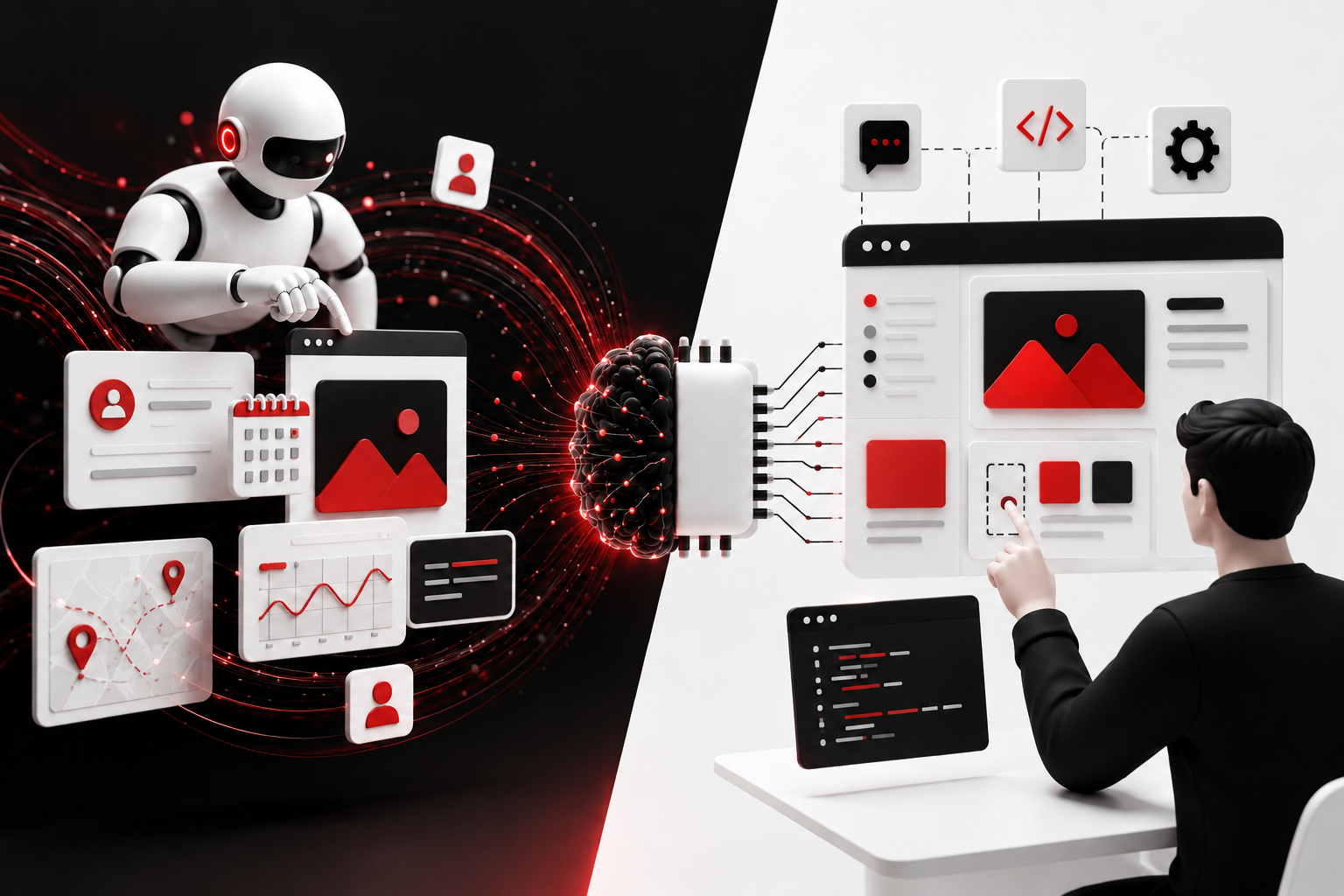
Something unprecedented happened in March 2026. Nielsen Norman Group — the gold standard of UX research — published an article titled "GenUI vs. Vibe Coding: Who's Designing?" The article drew a sharp line between two concepts that most people had been conflating: generative UI (where the AI decides to create an interface) and vibe coding (where the human tells the AI to create one).
That distinction matters more than most designers realize. Because it's not about which tool is better — it's about who holds design accountability when things go wrong.
Meanwhile, OpenAI just closed a $122 billion funding round, ChatGPT has 900 million weekly users, and Figma launched Make Kits on April 2nd — the day before this article was written — bringing design system context directly into AI-generated prototypes. The velocity is staggering.
But here's the uncomfortable truth: most of the industry is focused on what AI can build, while ignoring what it should build. That gap is where design either evolves or dies.
1. The GenUI Revolution: Interfaces That Design Themselves
What GenUI Actually Means
Generative UI isn't just another AI feature. It represents a fundamental shift in how we think about interfaces. As NNGroup defines it: GenUI is when "the AI system decides to produce a visual or interactive element — the system initiates the design."
Consider the difference:
- Traditional UI: A designer creates a flight search results page with fixed layouts.
- Vibe coding: A user says "Build me a flight booking app" and AI generates it.
- GenUI: A user says "Find me flights to Chicago" and the AI decides that the best response isn't text — it's an interactive calendar widget with personalized filters based on that user's history.
The AI made a design decision. No human designer was in the loop at the moment of interface creation. This is either thrilling or terrifying, depending on your perspective.
Why This Is Happening Now
Three converging forces make 2026 the inflection point:
- LLMs that understand context. Modern AI models can assess user intent, history, and constraints in real-time — the prerequisites for intelligent UI generation.
- Component-based architectures. Design systems built on tokens and components give AI something structured to compose from. Figma's new Make Kits literally teach AI about your design system via npm packages.
- User fatigue with static experiences. Users increasingly expect personalized, adaptive interfaces. A one-size-fits-all dashboard feels archaic when AI can tailor every element.
Real-World Example: The Delta Flight Concept
NNGroup illustrated this with a compelling scenario: a frequent flyer named Alex with dyslexia opens the Delta app. The GenUI system automatically applies a dyslexia-friendly font. When searching flights, it detects a major event on her travel dates and surfaces a warning. Results are ranked by her preferences (cost and travel time), window-seat availability is flagged, and red-eye flights she never takes are collapsed. Delta serves 190 million yearly flyers — GenUI makes this level of personalization feasible at scale.
2. Vibe Coding: The Democratization Trap
The Seductive Promise
Andrej Karpathy coined "vibe coding" in early 2025 with a deceptively simple pitch: describe what you want, and AI builds it. "Forget that the code even exists," he said. The idea exploded. By early 2026, vibe coding tools like v0, Cursor, and Claude Artifacts are mainstream.
The Problem Nobody Talks About
Here's what NNGroup's research exposed: vibe coding has a "specification spectrum." When someone says "Build me a trip planner," the AI makes hundreds of design decisions — layout, interaction patterns, information hierarchy. When someone says "Build me a trip planner with a sticky sidebar, date picker on the left, and results in a 3-column grid," the AI executes.
The first scenario leaves critical design decisions to a system with no understanding of the user's context, cognitive load, accessibility needs, or business goals. It's not design — it's delegation to a black box.
The Accountability Gap
NNGroup's key insight: "The line between them determines what we hold the AI accountable for: execution fidelity or design judgment."
When a vibe-coded app has poor discoverability, confusing navigation, or excludes users with disabilities — who's responsible? The user who asked for it? The AI that built it? The company that offered the tool? This accountability vacuum is the real crisis.
3. Design Tools Are Evolving — But Into What?
Figma's Strategic Pivot
Figma's product suite has evolved dramatically. As of April 2026, their lineup includes:
- Figma Design (core UI tool)
- Figma Make (AI-powered prototyping — with new Make Kits)
- Figma Sites (website publishing)
- Figma Slides (presentations)
- Figma Draw (illustration)
- Figma Buzz (content creation)
- Figma Weave (the newest addition)
The Make Kits announcement (April 2, 2026) is particularly significant. It allows teams to teach Figma's AI their design system through npm packages — bringing real components, data, and constraints into AI-generated prototypes. As Figma put it: "AI can generate a UI in seconds. The first draft looks convincing. But it's not your design system."
This addresses one of the core problems: AI-generated UIs that look polished but are disconnected from production reality. The gap between "nice mockup" and "shippable product" was the primary friction point.
The Compressed Design Process
NNGroup's March 2026 article "Design Process Isn't Dead, It's Compressed" challenged the growing narrative that designers should "throw out the process" and trust intuition. Their argument: what experienced designers call "intuition" is actually internalized process — compressed through years of practice.
AI tools accelerate this compression and democratize it. Vibe coding has shrunk the gap between an idea and something testable. "Exploring, making, learning, and refining can happen in a single afternoon."
But — and this is critical — this only works for experienced practitioners working in mature problem spaces. Junior designers don't have the internalized process to compress. Telling them to "skip process" is like telling a first-year medical student to operate on gut feeling.
4. The AI Chatbot Identity Crisis
Users Don't Know What They're For
NNGroup's research on site AI chatbots (March 2026) revealed a damning finding: most users don't understand what these chatbots do, don't notice them, and when they do try them, struggle to see what they offer beyond search or ChatGPT.
Key findings:
- Regular customers on sites with AI chatbots had never noticed or used them
- Chatbot icons were small, unlabeled, and blended into backgrounds
- Users had been burned by years of bad pre-LLM chatbots and carried that skepticism forward
- Even Home Depot's "Magic Apron" chatbot was invisible to frequent shoppers
The Real Problem: Purpose, Not Technology
The issue isn't chatbot quality — it's purpose definition. NNGroup found that chatbots succeed when they solve problems that existing features don't. They fail when they duplicate search, filters, or FAQ pages.
The takeaway for designers: if you can't articulate what unique value your AI chatbot provides that search cannot, you don't need a chatbot. You need to rethink your information architecture.
5. Outcome-Oriented Design: The New Paradigm
From Interfaces to Outcomes
NNGroup's "Era of AI Design" framework introduces outcome-oriented design: instead of designing single interfaces, designers define adaptive frameworks that respond to individual user goals.
This is a profound shift. Traditional design asks: "What should this screen look like?" Outcome-oriented design asks: "What does the user need to accomplish, and how can the interface adapt to get them there?"
What Designers Actually Do Now
In this paradigm, the designer's role shifts from pixel-pusher to:
- Constraint definer: Setting the boundaries within which AI can operate
- Outcome architect: Defining what success looks like for different user segments
- Quality auditor: Evaluating AI-generated experiences for accessibility, ethics, and brand alignment
- System thinker: Designing the rules, not the results
This is harder, not easier, than traditional design. It requires deeper understanding of user psychology, business strategy, and systems thinking.
6. The Changing Skill Landscape
New Roles Emerging
The World Economic Forum projects 45% job growth for UX/UI designers by 2030 — but the job description is transforming. New roles gaining traction in 2026 include:
- AI UX Designer: Specializing in human-AI interaction patterns
- Prompt Designer: Crafting the interactions between users and generative systems
- Design System Engineer: Bridging design tokens and code (critical for AI tools like Figma Make)
- AI Experience Auditor: Evaluating AI-generated experiences for quality and ethics
What's Becoming Less Valuable
- Pixel-perfect mockup creation (AI does this faster)
- Basic wireframing (vibe coding replaces this)
- Design system component building (AI can generate from tokens)
What's Becoming More Valuable
- Strategic thinking and problem framing
- User research methodology and rigor
- Accessibility and inclusive design expertise
- Cross-device and multimodal interaction design
- Ethical AI design frameworks
- Design system architecture (not component creation)
Sources
- NNGroup — "GenUI vs. Vibe Coding: Who's Designing?" (March 27, 2026)
- NNGroup — "Design Process Isn't Dead, It's Compressed" (March 13, 2026)
- NNGroup — "What Is Your Site's AI Chatbot for? Users Can't Tell" (March 20, 2026)
- NNGroup — "Outcome-Oriented Design: The Era of AI Design" (March 23, 2026)
- NNGroup — "Generative UI and Outcome-Oriented Design" (2024, updated 2025)
- Figma Blog — "Build With More Context and More Control in Figma Make" (April 2, 2026)
- Figma Blog — "Hard Problems Are Still Hard" (2026)
- The Verge — OpenAI $122B funding round, 900M weekly users (March 31, 2026)
- The Verge — Nothing AI glasses plans (March 31, 2026)
- The Verge — Apple Intelligence accidental China launch (March 30, 2026)
- World Economic Forum — Future of Jobs Report (45% UX/UI growth by 2030)
- Andrej Karpathy — "Vibe coding" coinage (February 2025)
- Figma Product Suite — figma.com (accessed April 2026)
- NNGroup — "The Methodological Problems Hiding in Your Research Tools" (March 13, 2026)
- NNGroup — "3 Tips to Make AI a Better Editor" (March 16, 2026)
Was this article helpful?
Earn Prompt Alchemist badge and 22 XP reward
GenUI, Vibe Coding, and the Designer Crisis: Who's Actually Designing in 2026? Quiz
Sign in to attempt this quiz and earn Xperience XP.
Login to Attempt Quiz